Resume Skills Section Guide
 Ayush Panthri · 13 min read
The skills section on your resume tells employers what you can do. But just listing 15 or 20 random skills will not help you get hired. To stand out, your skills must match the job you want. They should use the same words from the job description ad and connect to your past work stories.
For example, imagine you want a job as an IT Project Manager. Listing Java, Python, or Photoshop will not help much, even if you are good at them. Instead, the recruiter wants to see skills like Project Management, Agile, Jira, and Scrum. A good skills section is not about listing everything you know. It is about showing the hiring manager that you have the right tools for their job.
This guide will show you how to choose, write, and highlight the best skills on your resume.
By end of this you”ll know
What Is the Skills Section of a Resume?
A skills section is a type of quick checklist part of your resume where you list the abilities, knowledge, tools, and competencies that are relevant to the job you want. For Example: Skills like – Program Management,Strategic Planning, Portfolio & Roadmap Management, Cross-Functional Leadership, Stakeholder Management, Budgeting & Resource Allocation, Risk & Issue Management.

This skills section gives recruiters a quick way to understand your capabilities before they read your work experience in detail. It can also help your resume contain relevant terms from the job description, which is important when your resume is screened by an Applicant Tracking System (ATS).
Why Is the Skills Section Important? Hiring managers often look at hundreds of resumes for just one job. A clean skills section helps them instantly see if you are a good fit. For Example: If they are looking for a Business Analyst, their eyes will search for words like: Business Process Analysis, SQL, Agile, Jira, User Stories. If you have these skills but do not list them clearly, the recruiter might skip your resume entirely.
Types of Skills to Include on a Resume
When you creating your resume, it’s important to understand that skills can be presented in more than one way. Rather than limiting them to a single section, you can highlight your strengths throughout your resume from your career summary to your work achievements. First, let’s explore the main types of skills that can make your resume stand out.
Hard skills
Hard skills are competencies and technical knowledge that people gain through education, training, certifications, or hands-on experience. These are practical, job-related skills that can be measured and help professionals perform their work effectively. These skills are useful both at work and in everyday life. Employers value hard skills because they show you can handle job-specific tasks and meet their demands.
Examples: Content creation, Data analysis, Risk Management, Financial Modeling, Business Analysis, Database management, Machine learning, System administration, Project management, Web development.
Technical Skills
Technical skills are the specialized knowledge and abilities required to use specific tools, technologies, software, equipment, or processes in a particular field. These skills are usually learned through education, training, certifications, or hands-on experience. Technical skills are a type of hard skill and are important because they help professionals complete job-related tasks successfully.
Examples: Python, Java, SQL, AWS, Salesforce, Tableau, Power BI, Git, SAP, React.js.
Soft Skills
Soft skills are personal qualities and people skills that help you work well with others and handle different situations at work. These skills are not related to technical knowledge but are important for communicating, teamwork, and building good relationships.This is very important when recruiters compare applicants with similar backgrounds in work and education. Therefore your resume should feature a strong and influential soft skills section.
Examples: Communication, Teamwork, Problem-solving, Leadership, Time management, Critical thinking, Conflict resolution.
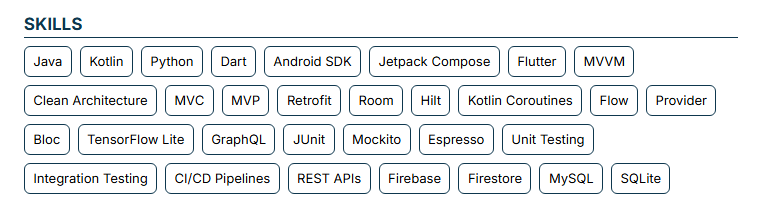
Should technical skills and soft skills be listed in separate sections on a resume?
It is generally recommended to include both technical and soft skills under a single Skills section to keep the resume organized and easy to read, you can see clearly in the given image below.

Job-Specific Skills
Job-specific skills are the abilities and knowledge needed to perform a particular job or profession. These skills are directly related to the tasks and responsibilities of a specific role. Unlike general skills such as communication or teamwork, job-specific skills vary from one profession to another.
People usually develop these skills through education, training programs, certifications, internships, or hands-on work experience. Employers look for job-specific skills because they show that a candidate can perform the duties of the position effectively.
For example, a Digital Marketing Manager may need: SEO, Google Ads, Meta Ads, Content Strategy, Conversion Rate Optimization, Google Analytics, Keyword Research.
A Financial Analyst may need: Financial Reporting, Financial Modeling, Forecasting, Budgeting, Variance Analysis, Excel.
How to Choose the Right Skills for Your Resume
Choosing the right skills for your resume is essential because it helps employers quickly see that you are qualified for the position. Instead of listing every skill you possess, focus on the skills that are most relevant to the job you are applying for and start with the job you want then identify which skills the employer is actually looking.
For Students and Freshers
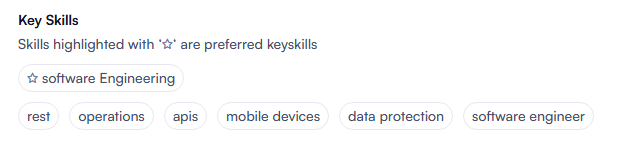
As a student or fresher, you may not have much work experience, but you still have valuable skills that employers look for. When you choosing skills for your resume, focus on the abilities that are relevant to the job, internship, or training program you are applying. Review the job description carefully and identify the skills the employer requires. Then, include the skills you have gained through your education, projects, coursework, certifications, volunteer work, or extracurricular activities.
Example: The job description is one of your best sources for identifying relevant skills, most companies provide their full job details like their requirements, qualification, skills and experience which help job seekers for identifying skills that employers want from your resume, you can see clearly in the given below image.
For Experienced Professionals
For experienced professionals, your resume skills section should focus on the abilities that are most relevant to your target role and demonstrate the expertise you have developed throughout your career. Employers expect experienced candidates to showcase skills that prove they can perform the job effectively and contribute immediately. Instead of listing every skill you have learned, highlight the ones that align with the job requirements, industry standards, and your professional achievements.
Example: A Digital Marketing Manager with 8 years of experience might highlight skills such as SEO, Google Analytics, Content Marketing, Campaign Management, Marketing Automation, and Team Leadership because these skills directly support the responsibilities of the role.
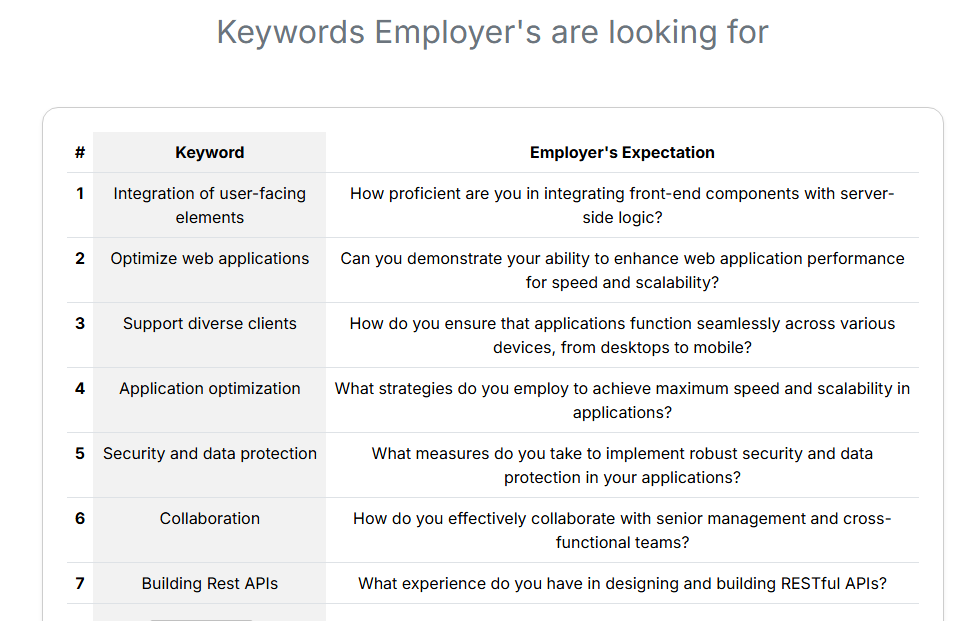
You can also use our free JD Keyword finder tool by simply copy & paste your job description into it and this tool provide you keywords that recruiters are highly expecting from your resume and it also helpful for passing ATS scan. You can see clearly in the given below image.
How to Write Skills on a Resume
Once you have identified the right skills for your resume, the next step is to present them in a clear and professional way. In our Resume Builder, you can showcase your skills using the following two methods:
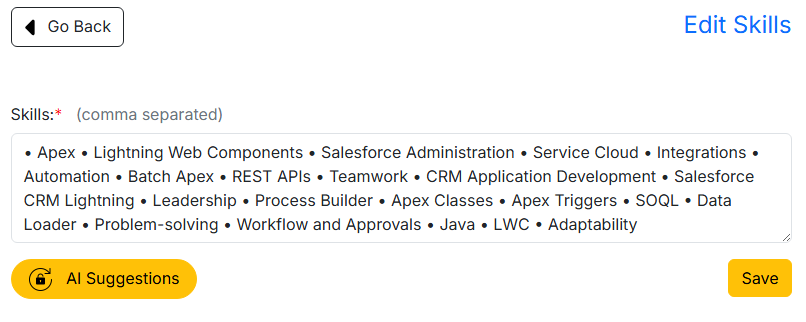
1. Comma Separated Skills
This is the simplest and most commonly used format. In which all your relevant skills are listed in a single line or paragraph and separated by all skills in commas you can see in the given below image.
Example:
Python, SQL, Data Analysis, Microsoft Excel, Power BI, Problem Solving, Teamwork, Communication
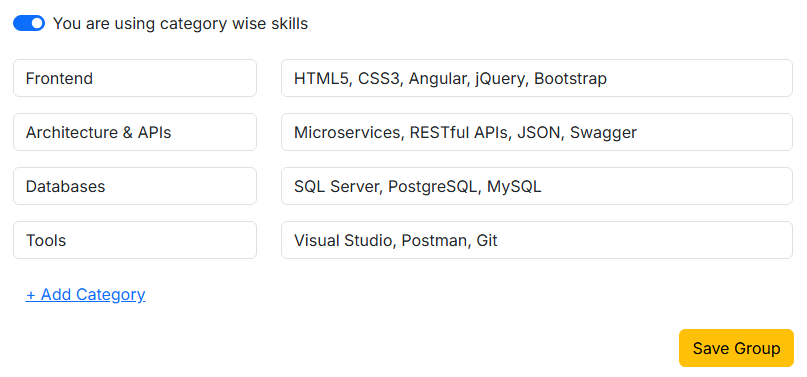
2. Category-wise Skills
In this format, skills are grouped into relevant categories. This makes your resume more organized and helps employers quickly understand your areas of expertise clearly you can see in the given below image.
Example: Programming Languages: Python, Java, C++
Data Analysis Tools: Excel, SQL, Power BI, Tableau
Soft Skills: Communication, Teamwork, Problem Solving
If you want to build a stronger resume? You can use our AI Resume Builder Tool and create a skills section that stands out to recruiters.
How to Highlight Your Key Skills Throughout Your Resume
Your skills section shouldn’t be the only place where important skills appear. You can also highlight them in your experience, projects, achievements, and certifications sections. When relevant skills appear consistently throughout your resume, they become more credible and impactful.
1. Use Skills in Your Resume Summary
Your resume summary is one of the first sections a recruiter reads. It provides a quick overview of your experience, qualifications, and key skills.
Including relevant skills in your summary helps employers immediately understand whether you are a good match for the role.
Example:
| Weak Summary | Strong Summary |
|---|---|
| Experienced professional with strong communication and leadership skills. | IT Risk professional with 9+ years of experience in ITGC, SOX 404 compliance, risk assessment, control design, testing, and remediation across enterprise environments. |
| This statement is very generic. Almost any candidate could write it. | This version is much stronger because it: • Includes job-specific skills • Uses industry terminology • Demonstrates relevant experience • Matches keywords employers are searching for |
2. Use Skills in Your Work Experience
Your Work Experience section is the best place to prove that you have the skills listed on your resume. However, when you show how you applied that skill in your job, it becomes more believable and valuable and employers want to see how you used those skills in real situations.
Example:
Instead of only listing skills like Project Management, Data Analysis, and Team Leadership, show how you used them in your experience section.
| Project Manager | ABC Company • Managed cross-functional projects and delivered them on time using strong project management skills. • Analyzed project data to identify risks and improve efficiency, demonstrating data analysis skills • Led a team of 10 members to successfully complete key business initiatives, showcasing team leadership abilities. |
3. Use Skills in Achievements
Your achievements section shows the results you achieved by using your skills. While the Skills section tells employers what you can do, your Achievements section proves the impact of those skills. Recruiters are often more interested in results than responsibilities. Showing achievements helps them understand how your skills contributed to business success.
As shown in the table below, highlighting relevant skills through measurable achievements makes the Achievements section more impactful.
| Example: Data Analysis • Used data analysis skills to identify process inefficiencies, reducing reporting time by 40%. Project Management • Applied project management skills to deliver a critical project two weeks ahead of schedule. Customer Service • Leveraged customer service skills to improve customer satisfaction scores from 85% to 95% |
4. Use Skills in Projects
The Projects section is a great place to showcase your skills, especially if you are a student, recent graduate, career changer or have limited work experience. Projects allow you to demonstrate how you applied your skills to solve problems, complete tasks, or achieve specific outcomes. As you can see in the table below, the Project section looks stronger when the relevant skills are clearly demonstrated in it.
| Example: Software Development Project Inventory Management System • Developed an inventory management application using Java, SQL, and database management skills. • Designed features for tracking products, updating stock levels, and generating reports. • Improved data accuracy and streamlined inventory tracking. |
5. Use Certifications to Support Specialized Skills
Certifications can strengthen your resume by proving that you have learned and validated specific skills through formal training or examinations. While skills tell employers what you can do, certifications provide evidence that you have developed those skills and understand industry standards.
Example: Instead of simply listing: Project Management, Cloud Computing, Cybersecurity. You can support these skills with certifications such as:
- Project Management → PMP (Project Management Professional)
- Cloud Computing → AWS Certified Solutions Architect
- Cybersecurity → CompTIA Security+
This makes your skills more convincing because employers can see that your knowledge has been formally recognized.
Want to improve your Skills section? This video covers the best way to organize your skills, where to place them on your resume, and how to showcase your expertise effectively.
Most In-Demand Resume Skills by Industry
The skills employers look for are depends on the industry, job role, and your experience level. Below are the examples of skills that are commonly search after in different industries:
1. IT & Software
These skills are often required for software development, IT support, cloud engineering, cybersecurity, and data-related roles.
- Java
- Python
- JavaScript
- SQL
- Cloud Computing
- AWS
- Cybersecurity
- Data Analysis
- DevOps
- Agile
2. Digital Marketing
These skills help businesses attract customers, increase online visibility, and improve marketing performance.
- SEO (Search Engine Optimization)
- Content Marketing
- Google Ads
- Meta Ads
- Email Marketing
- Google Analytics
- Keyword Research
- Social Media Marketing
- Conversion Rate Optimization (CRO)
3. Finance & Banking
These skills are commonly required in accounting, banking, investment, auditing, and financial planning roles.
- Financial Analysis
- Financial Modeling
- Risk Management
- Forecasting
- Budgeting
- Financial Reporting
- Microsoft Excel
- Investment Analysis
- Compliance
- Data Analysis
4. Sales
These skills help professionals build customer relationships, generate revenue, and achieve sales targets.
- B2B Sales
- Lead Generation
- Account Management
- CRM (Customer Relationship Management)
- Negotiation
- Sales Forecasting
- Pipeline Management
- Client Relationship Management
- Business Development
5. Operations
These skills are valuable for improving efficiency, reducing costs, and managing business operations effectively.
- Process Improvement
- Operations Management
- Supply Chain Management
- Vendor Management
- Quality Management
- Inventory Management
- Lean Six Sigma
- Data Analysis
6. Human Resources (HR)
These skills support hiring, employee development, performance evaluation, and workforce management.
- Talent Acquisition
- Employee Relations
- Performance Management
- HRIS
- Workforce Planning
- Learning & Development
- Compensation & Benefits
- Recruitment
7. Project Management
These skills help professionals successfully plan, execute, and deliver projects on time and within budget.
- Project Planning
- Agile
- Scrum
- Risk Management
- Stakeholder Management
- Budget Management
- Resource Planning
- Project Scheduling
- Jira
- Confluence
Frequently Asked Questions (FAQ)
Where should I place the skills section on my resume?
For most resumes, the skills section can appear after the professional summary and before or after the work experience section. But in technical roles, placing relevant technical skills near the top can help recruiters identify your capabilities quickly.
How many skills should I include on my resume?
There is no fixed number of skills that works for every resume. As a practical starting point, 10-15 highly relevant skills are often more useful than listing 30-40 loosely related skills.
Is the skills section enough for ATS?
No. An ATS-friendly resume requires more than a skills section, your relevant keywords should naturally appear across areas such as: Certifications, Summary, Skills, Work experience and in Projects.
Are skills and keywords different?
Yes because a skill is something you can do or knowledge you possess and a keyword is a word or phrase that helps describe your experience and match your resume to a job requirement.
Core Competencies vs. Skills Section: What’s the Difference?
They are often used interchangeably, but they can serve slightly different purposes. A skills section usually lists specific abilities, tools, technologies, or areas of expertise and core competencies section usually highlights broader professional capabilities.
For example: Core Competencies – Team Leadership, Strategic Planning, Risk Management, Stakeholder Management, Process Improvement.
Author – Ayush Panthri
Connect on LinkedIn

Reviewer – Kunal Saxena
Kunal is a seasoned Technical Resume Writer with over 13 years of experience working with startups, mid-sized firms, and top global companies like Goldman Sachs and EY. He brings deep domain expertise across tech, education, insurance, e-commerce, and investment banking.
He has helped hundreds of professionals from top firms—including Apple, Meta, Google, Adobe, and Amazon — land interviews and advance their careers globally. His approach blends real-world hiring insight with high-impact resume strategy.
Kunal is an active member of Career Thought Leaders and the Resume Writing Academy, staying current with global resume trends and recruiter expectations.
Connect on LinkedIn
Amit got 2 Offers with our resume builder

My experience was truly outstanding, I got 3-5 interview calls and 2 job offers. The resume wasn't just focused on my current job - it captured my consulting, technical and leadership skills as well. Plus this was much more affordable
Data Engineer - Deloitte